
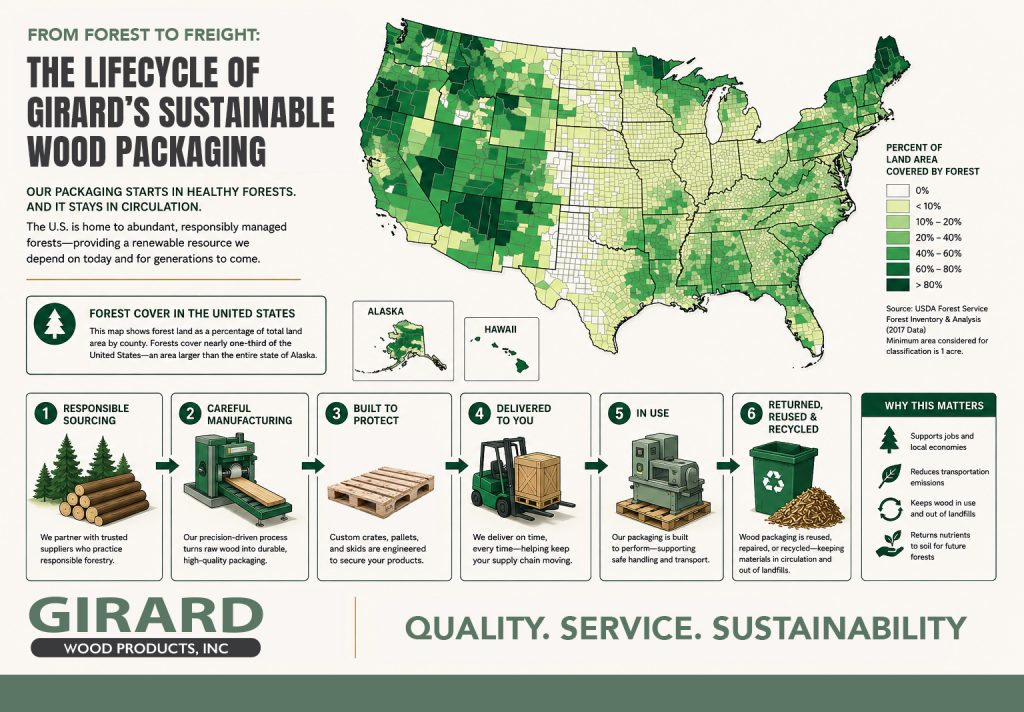
From Forest to Freight: The Lifecycle of Sustainable Wood Packaging
How Wood Packaging Supports a Smarter, More Sustainable Supply Chain
In today’s industrial and logistics landscape, sustainability is no longer just a buzzword, it’s a priority. Manufacturers, distributors, and logistics providers across the country are searching for ways to reduce waste, improve efficiency, and minimize environmental impact without sacrificing durability or performance.
That’s where wood packaging continues to stand apart.
At Girard Wood Products, we believe sustainability and reliability go hand-in-hand. From responsibly sourced lumber to reusable pallets and custom crating solutions, wood packaging plays a critical role in creating a more efficient and environmentally conscious supply chain.
Here’s a closer look at the lifecycle of sustainable wood packaging; from forest to freight.
1. Responsibly Sourced Raw Materials
Every quality wood packaging solution starts with responsible forestry practices.
Wood is one of the few truly renewable industrial materials available today. When sourced from responsibly managed forests, timber can be continually replenished while supporting healthy ecosystems and long-term sustainability.
Unlike plastic packaging, which relies heavily on petroleum-based materials, wood naturally regenerates over time and stores carbon throughout its lifecycle.
At Girard Wood Products, sustainability starts with thoughtful sourcing and efficient material utilization.
Key Benefits:
Renewable resource
Lower carbon footprint than many alternative materials
Supports domestic forestry and manufacturing industries
Naturally biodegradable and recyclable
2. Precision Manufacturing with Minimal Waste
At Girard Wood Products, every packaging solution is built with durability, efficiency, and real-world performance in mind.
Sustainable Manufacturing Practices Include:
Efficient lumber utilization
Reusing scrap materials when possible
Designing right-sized packaging solutions
Reducing unnecessary material consumption
3. Reuse and Repair Extend Product Life
One of the biggest sustainability advantages of wood packaging is its ability to be reused and repaired.
Unlike many single-use packaging materials, wood pallets and crates can often remain in circulation for years with proper maintenance.
Damaged components can frequently be repaired rather than discarded entirely, reducing waste while lowering replacement costs for businesses.
This creates a more circular packaging lifecycle that supports both sustainability goals and operational efficiency.
Why Reusability Matters:
Reduces landfill waste
Lowers long-term packaging costs
Extends product lifespan
Supports circular supply chain initiatives
4. Reliable Performance Reduces Shipping Waste
Packaging failures create more than just inconvenience, they create waste.
When products are damaged during transit, companies often face replacement costs, additional freight expenses, production delays, and excess material waste.
Strong, properly engineered wood packaging helps protect products throughout the supply chain, especially for:
Industrial equipment
Heavy machinery
Fragile components
Oversized shipments
Export freight
Custom wood packaging solutions reduce product movement, improve load stability, and help ensure products arrive safely the first time.
That reliability plays a direct role in sustainability by minimizing avoidable waste and reducing unnecessary reshipments.
5. Recycling and End-of-Life Sustainability
At the end of its lifecycle, wood packaging still provides value.
Wood materials can often be:
Recycled into mulch or animal bedding
Repurposed for secondary industrial uses
Ground into biomass fuel
Naturally biodegraded over time
Compared to many synthetic packaging materials, wood offers a significantly more sustainable end-of-life outcome.
This makes wood packaging an ideal fit for organizations working toward broader environmental goals.
Sustainable Packaging That Performs
Sustainability should never come at the expense of performance.
At Girard Wood Products, we build packaging solutions designed to protect products, support efficient logistics, and contribute to a more sustainable manufacturing process.
From new pallets to other custom wood packaging products, our team works closely with customers to deliver reliable wood packaging tailored to their operation.
Whether your focus is durability, compliance, sustainability, or efficiency — we’re here to help.
Partner with Girard Wood Products
Looking for sustainable wood packaging solutions built for real-world performance?
Contact Girard Wood Products today to discuss custom pallets, crates, skids, and industrial packaging solutions designed around your business.